
Why adding a warehouse can reduce total stock
A warehouse is not a place to store more. It is the way a chain takes control of replenishment time — and replenishment time is what decides how much stock the whole system has to finance.
The paradox
Your own warehouse looks, at first, like a contradiction. You have to rent or build the space, hire people, receive goods, put them away, pick them, load them and drive them out to the pharmacies. The distributor can already deliver straight to the door. Why add another operation and another place for stock to sit?
You can add a warehouse and end up with less stock in the network than before.
The answer becomes obvious once you stop thinking of the warehouse as a building.
A warehouse is not there to store more. It is there to control replenishment time and the total stock of the system.
When not having a warehouse costs more than having one
For a small chain, direct distributor deliveries can be economically optimal. Your own warehouse adds space, staff, handling and transport. But as the chain grows, a different cost grows with it — the cost of decentralised supply. You are paying it when:
- each pharmacy holds protective stock because replenishment is long or unreliable
- the same safety stock is duplicated in dozens of locations
- large supplier lots have to be placed in pharmacies whose local demand is far smaller
- different supplier schedules force locations to defend themselves with extra stock
- one pharmacy’s local surplus cannot quickly become another’s availability
- receiving many external deliveries eats significant pharmacy time
- total demand would already justify large purchases, but the chain cannot receive and distribute that volume
The comparison is not the cost of a warehouse against zero. It is the cost of a warehouse against the cost of the entire decentralised supply system.
In our founder’s experience many chains postpone this transition and stay for a long time in the range of roughly 10–20 pharmacies. That is not a universal threshold — geography, network density, the distribution model and the market all differ.
What actually determines how much stock you need
Not the calendar. The period you have to survive before the next reliable replenishment.
Count from the moment a sale creates the need to restore stock, to the moment replenishment is available for sale again. For a full cycle down to the pharmacy that includes: the wait for the next ordering cycle, forming and sending the order, the supplier or warehouse receiving it, processing and picking, shipping and transport, receiving at the pharmacy, and putting away until the product can actually be sold.
The longer that cycle, and the more it fluctuates, the more stock is required to protect sales. With steady demand of three packs a day, one day of protection is three packs; two days, six; thirty days, ninety — and that is before any allowance for variation in demand or supply.
Most of a pharmacy’s range is slow
A sale once every two or three weeks is not an exception in pharmacy. For a large part of the range it is normal.
As a practical estimate from our founder’s work, around 20% of product lines have at least one sale in a typical week; around 80% sell less often. That is a share of SKUs, not of revenue or packs, and it varies by format and market.
Take even a faster item from that long tail — one that sells about once a week. If an external delivery arrives weekly, the pharmacy holds a second unit so that it is not empty after the first sale. If your own warehouse returns the sold pack the following morning, that doubled local protection is often no longer needed.
On one SKU the difference looks trivial. Across thousands of lines and hundreds of pharmacies it becomes capital.
The model: 200 packs become about 130
A teaching model — not client data, and not a promise for any particular chain.
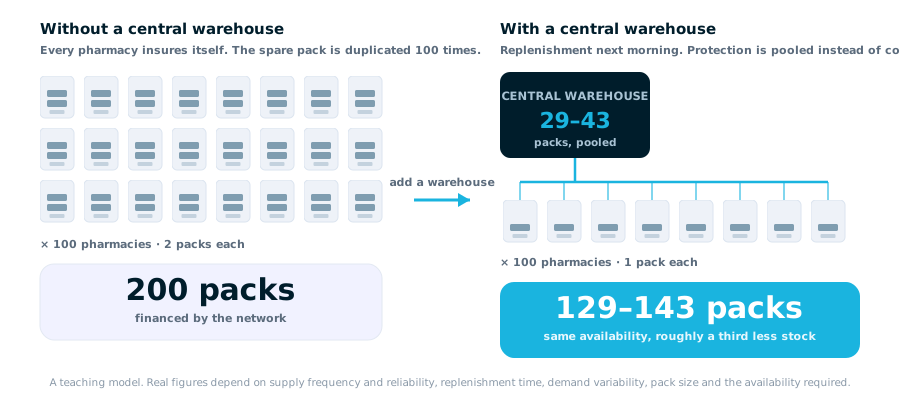
100 pharmacies. One product, selling on average about once a week in each. Without a central warehouse, each pharmacy is replenished about once a week, and holds two packs so as not to be empty after a sale.
Without a warehouse: 100 pharmacies × 2 packs = 200 packs in the system. The protective unit is duplicated a hundred times.
With a central warehouse that can replenish daily or next morning, and is itself replenished often and reliably enough to hold 2–3 days of aggregated demand: one pack stays in each pharmacy, roughly 29–43 sit centrally — about 129–143 packs in total, at the same availability.
Do not memorise the percentage. Memorise the mechanism: one duplicated protective unit in every pharmacy is replaced by a much smaller pooled stock further up the chain.
Real numbers depend on how frequently and reliably the central warehouse is supplied, the replenishment time to pharmacies, the variability and correlation of demand, pack size, minimum local stock, and the availability you require. If the central warehouse is itself replenished rarely or unreliably, it needs more stock and the effect is different.
Why a hundred pharmacies need less total insurance than a hundred independent stocks
In a single pharmacy, demand for one product is lumpy. Today nothing. Tomorrow one or two packs. Then nothing for days. If every location insures itself against that unevenness alone, protective stock is duplicated across the whole network.
A central warehouse sees the aggregated demand of many locations. It pools not only volume but part of the local uncertainty. The effect is strongest when local fluctuations are at least partly out of step with each other; if every location spikes at the same moment, pooling helps less.
What changes when the pack is back on the shelf next morning
One possible cycle:
- Evening — the system receives current stock and sales.
- Night — the requirement is calculated and the order is formed.
- Early morning — the warehouse picks orders by route.
- Morning / before noon — goods are received and available in the pharmacy again.
Against an external supplier the difference is sometimes not weeks but a few hours, or one ordering cycle. That cycle is what decides how much extra stock has to sit locally.
What one project actually saw
In one project the supply architecture was rebuilt: instead of independent large deliveries to regional warehouses, goods went to a central warehouse and from there to the regions in small, frequent consignments. Total warehouse stock fell by at least about 30%, with the biggest drop at the regional warehouses. Alongside it: less space needed, more even goods-in, less warehouse labour, and a system that was simpler to manage.
A second client later reported a similar effect after moving to a central architecture — stock down by more than 30% by their own account, with lower operational demands on the warehouse. Two projects do not prove a universal percentage. They do support the mechanism: aggregation and more frequent replenishment can reduce system stock even though another warehouse has appeared in the chain.
Four things a warehouse does that are not storage
It breaks bulk — and it has to be told to
Suppliers ship in large factory packaging; an individual pharmacy needs far less. The central warehouse has to convert a large inbound lot into quantities that match real pharmacy demand. We once saw the reverse: a warehouse began shipping onward mostly in full factory cartons. It saved picking effort in the warehouse, but network stock rose and cash flow suffered. A local saving on a warehouse operation can be very expensive for the capital of the whole chain.
It gives the pharmacist time back
With an external delivery, the pharmacy checks the supplier’s consignment. If the delivery comes from your own warehouse, and scanning, picking and dispatch control there are reliable, that re-check can be substantially reduced and moved to exception control — as far as your processes and local regulation allow. In a large location that can change the need for a separate goods-in function.
It buys time during a market shortage
When external distributors can no longer supply, a pharmacy that depends purely on external replenishment cannot restore availability once its local stock runs out. A chain may still have stock centrally. The product has already disappeared from the market; inside your network it is still there. That is not infinite protection, but it is extra time in which you can keep serving customers after others cannot.
It concentrates buying power
When a supplier makes one delivery to a central warehouse instead of dozens or hundreds to individual pharmacies, hundreds of small orders become one visible volume — and the chain has a stronger position for discussing volume and commercial terms.
A warehouse concentrates more than goods. It concentrates purchasing power.
Which goods should actually go through it?
The answer should not be dogmatic. Not every product on every market has to pass through your own warehouse. The question is which part of the flow creates more total economic value if the chain controls it directly.
Sometimes a direct supplier delivery really is better. Sometimes a mixed model is sensible. What you must not do is minimise one local operation at the expense of the whole system: total stock, availability, replenishment speed, delivery, pharmacy labour, goods-in, losses from stockouts, capital, and resilience during shortage.
And once demand is aggregated and a supplier can deliver to a single point, the next question arrives on its own: why keep buying only through the distributor? That is the subject of the next article.
Related: Redistribution: use the stock you already own · Does buying cheaper mean earning more? · How to reduce overstock
The thinking in this article draws on The Evolution of the Pharmaceutical Market, a book by our founder Serzas Gutsaga.
Common questions
At what size does a pharmacy chain need its own warehouse?
How can adding a storage point reduce total stock?
See this on your own data.
The free demo begins with a real simulation on your history — where sales, cash and time are leaking, and what the system would have done instead.